 Since 2000
Tarot: The Sacred Language of Symbols, Fate and Self-Discovery
What Is Tarot?
Tarot is an ancient symbolic system that speaks the language of the soul.More than a tool for prediction, Tarot is a mirror of consciousness, revealing hidden patterns, subconscious truths, karmic themes, and future possibilities.Each Tarot card carries layered meanings drawn from mythology, astrology, numerology, psychology, and sacred symbolism.
Used for centuries across cultures, Tarot serves as a guide for introspection, decision-making, spiritual growth, and understanding the interplay between fate and free will. Whether consulted for clarity, healing, or foresight, Tarot unfolds wisdom through archetypes that resonate deeply with the human experience.
This page serves as the foundation of Tarot exploration, from which all Tarot readings, card generators, spreads, and interpretations emerge. Welcome aboard…
The Structure of the Tarot Deck
A traditional Tarot deck consists of 78 cards, divided into two main sections:
- The Major Arcana (22 cards) – The soul’s journey and life-changing archetypes
- The Minor Arcana (56 cards) – Daily life experiences, emotions, challenges, and actions
Together, these cards form a complete symbolic map of existence.
The Major Arcana: The Soul’s Journey
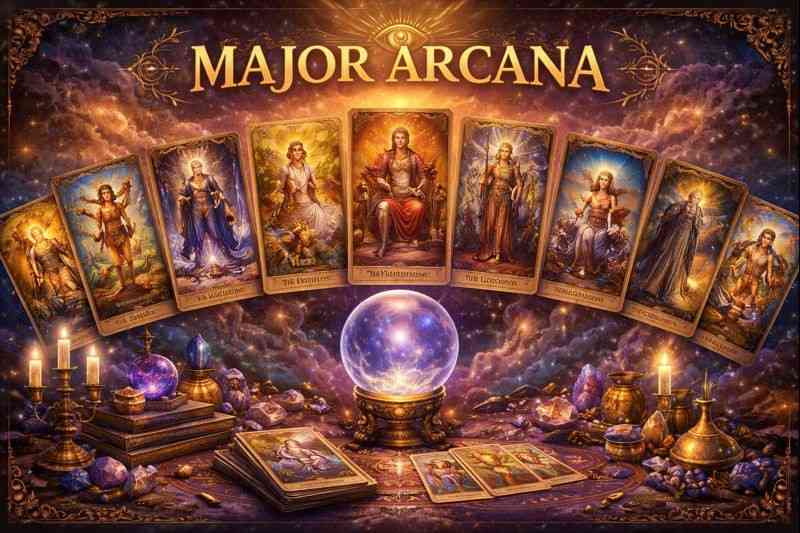
The Major Arcana represents profound spiritual lessons, karmic milestones, and archetypal forces shaping destiny. These cards describe pivotal moments that leave a lasting impact on one’s life path.
Key Major Arcana Themes
- Destiny and karmic turning points
- Spiritual awakening and transformation
- Life purpose and soul evolution
- Major decisions and irreversible changes
Some Major Arcana Archetypes
- The Fool – New beginnings, trust, infinite potential
- The Magician – Manifestation, willpower, creation
- The High Priestess – Intuition, hidden knowledge, the subconscious
- The Empress – Fertility, abundance, nurturing energy
- Death – Endings, rebirth, transformation (not literal death)
- The Tower – Sudden upheaval, truth revealed
- The World – Completion, integration, fulfillment
When Major Arcana cards dominate a reading, the message points to life-defining themes rather than temporary situations.
The Minor Arcana: Life in Motion
The Minor Arcana reflects everyday life—our thoughts, emotions, relationships, challenges, and actions. These cards show how larger forces play out in practical reality.
The Minor Arcana is divided into four suits, each aligned with an element and area of life.
The Four Tarot Suits and Their Meanings
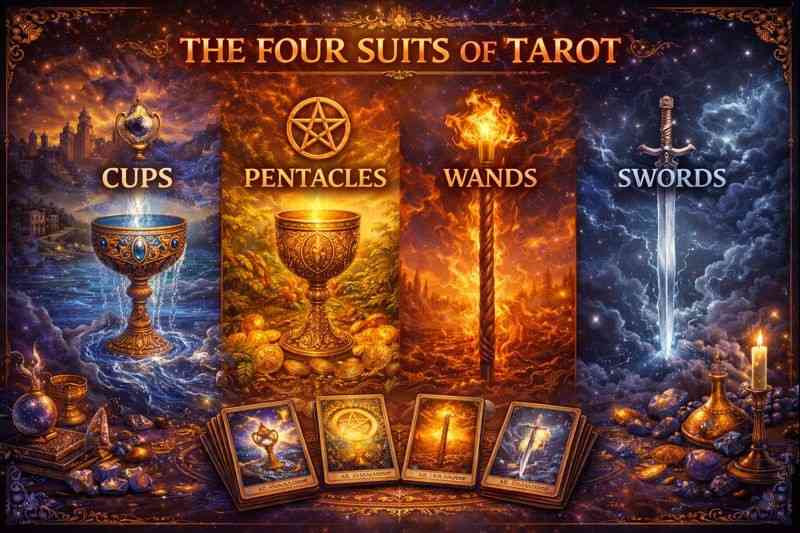
Wands (Element: Fire)
Wands govern energy, ambition, creativity, passion, and purpose.
Themes include:
- Career and goals
- Motivation and drive
- Spiritual calling
- Personal growth
Wands often appear when action, initiative, or inspiration is required.
Cups (Element: Water)
Cups represent emotions, relationships, intuition, and inner life.
Themes include:
- Love and relationships
- Emotional healing
- Spiritual sensitivity
- Dreams and feelings
Cups reveal the heart’s truth and emotional undercurrents.
Swords (Element: Air)
Swords symbolize thought, communication, truth, and conflict.
Themes include:
- Decision-making
- Mental clarity or confusion
- Truth vs illusion
- Challenges and lessons
Swords often highlight areas where honesty and awareness are essential.
Pentacles (Element: Earth)
Pentacles relate to material reality, stability, finances, and long-term growth.
Themes include:
- Career and money
- Health and body
- Home and security
- Practical efforts
Pentacles emphasize patience, responsibility, and tangible outcomes.
Court Cards: The Faces of Human Experience
Each suit contains four Court Cards, representing personality types, stages of maturity, or people influencing a situation.
- Page – Learning, curiosity, beginnings
- Knight – Action, movement, pursuit
- Queen – Mastery, inner authority, receptivity
- King – Leadership, responsibility, external authority
Court cards may indicate people, inner qualities, or roles the seeker is being asked to embody.
Upright and Reversed Cards
Tarot cards may appear upright or reversed, adding nuance to interpretation.
- Upright cards express the energy in its natural or outward form
- Reversed cards may indicate:
- Internalized energy
- Delays or blocks
- Shadow aspects
- The need for reflection
Reversals are not inherently negative; they often signal inner work or transformation in progress.
Types of Tarot Readings
From this Tarot foundation, many reading styles emerge:
- Daily Tarot guidance
- Love and relationship readings
- Career and finance Tarot
- Spiritual path and soul purpose readings
- Yes/No Tarot
- Past–Present–Future spreads
- Celtic Cross and advanced spreads
Each reading draws from the same symbolic system, adapted to intention and context.
Why Tarot Remains Relevant Even Today
In a fast-changing world, Tarot offers stillness, insight, and perspective. It helps individuals:
- Navigate uncertainty
- Understand emotional patterns
- Make aligned decisions
- Connect with intuition
- Explore spiritual growth
Tarot evolves with time while retaining its ancient wisdom.
Tarot as a Living Oracle
Tarot is not merely a deck of cards; it is a living oracle, shaped by intention, intuition, and awareness. Whether used for guidance, reflection, or divination, Tarot opens a dialogue between the conscious mind and the deeper wisdom within.
Astrology + Tarot Integration: A Unified Cosmic Language
Tarot and astrology are deeply interconnected symbolic systems. Both describe the movement of energy, consciousness, and destiny using archetypes to reflect life experiences. Astrology shows when and where energies unfold, while Tarot reveals how those energies are experienced and navigated.
Together, they form a powerful divination and self-understanding tool.
Astrological Correspondences in Tarot
Major Arcana and Astrology
Each Major Arcana card is associated with a zodiac sign, a ruling planet, or an elemental force.
Examples:
- The Emperor – Aries (authority, leadership)
- The Lovers – Gemini (choice, duality)
- The Chariot – Cancer (emotional control, direction)
- The Devil – Capricorn (material attachment, power)
- The Star – Aquarius (hope, higher vision)
These correspondences allow Tarot readings to reflect planetary transits and natal chart themes.
Minor Arcana and Zodiac Decans
The Minor Arcana is linked to astrological decans—each sign’s 10-degree divisions.
- Each numbered card (2–10) corresponds to a specific zodiac decan
- This adds precision to timing and situational interpretation
- Especially powerful in predictive and transit-based Tarot readings
Tarot Suits and the Elements
The four Tarot suits align directly with astrological elements:
- Wands – Fire signs (Aries, Leo, Sagittarius)
- Cups – Water signs (Cancer, Scorpio, Pisces)
- Swords – Air signs (Gemini, Libra, Aquarius)
- Pentacles – Earth signs (Taurus, Virgo, Capricorn)
This elemental link allows Tarot to mirror natal chart balances and imbalances.