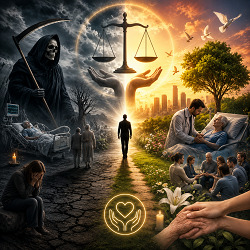
The subject of death has long been one of the most complex and sensitive areas within astrology. In traditional Medical Astrology, considerable effort was devoted to determining the timing and nature of death. However, modern practice approaches this topic with a strong emphasis on ethics, responsibility, and respect for the individual.
Rather than attempting to predict the exact timing of death, contemporary astrology focuses on understanding the processes of transformation, cycles of life, and the conditions that influence vitality and decline. Death is viewed not as a singular event to be forecast with certainty, but as part of a broader continuum of existence.
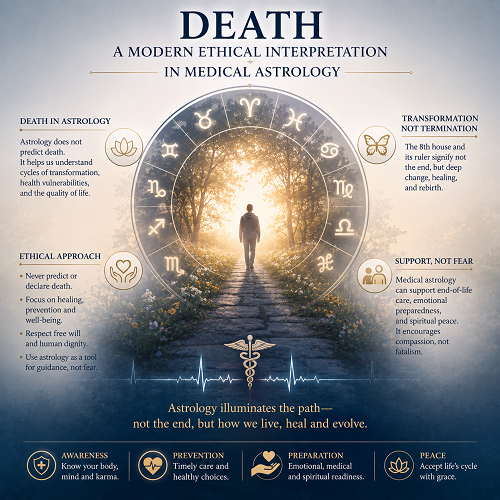
In the astrological chart, the Eighth House is most commonly associated with death and transformation. However, its meaning extends far beyond physical death. It represents profound change, endings, and the processes through which one state of being transitions into another. This may include psychological transformation, the release of old patterns, or significant life transitions.
The Fourth House is also relevant, particularly in relation to the end of life and the conditions surrounding it. It reflects the foundation of life and its eventual conclusion, often symbolizing the environment or circumstances in which life comes to rest.
The condition of the Ascendant and the Hyleg, as discussed in earlier chapters, plays a central role in understanding vitality. Rather than indicating the exact moment of death, these factors reveal the strength and sustainability of the life force. A strong and well-supported chart suggests resilience and longevity, while a more vulnerable chart may indicate the need for greater care and awareness.
Planetary influences, particularly from Saturn, Pluto, and sometimes Mars, are often associated with themes of endings, limitation, and transformation. Saturn represents the passage of time and the process of aging. Pluto, though not traditionally included in classical Medical Astrology, is widely recognized in modern practice as a symbol of deep transformation and regeneration.
It is important to understand that these influences do not act in isolation. They are part of a larger system in which many factors interact. The timing of major life events, including the cycle of life, is influenced by a complex interplay of planetary cycles, environmental conditions, and personal circumstances.
Modern Medical Astrology emphasizes that predicting death with certainty is neither reliable nor ethical. Such predictions can create fear, anxiety, and a sense of worry that undermines the individual’s ability to live fully. Instead, astrology is used as a tool for understanding and empowerment, helping individuals make informed choices about their health and well-being.
From a philosophical perspective, death is seen as a natural part of the life cycle. Astrology reflects this cycle through the movement of planets and the changing patterns of the chart. Each phase of life has its own significance, and the end of life is understood as a transition rather than an absolute ending.
In practical terms, the study of death in astrology can provide insight into periods of transformation and the need for introspection or change. These periods may involve letting go of tough patterns, addressing unresolved issues, or preparing for new phases of existence. By recognizing these cycles, individuals can approach life with greater awareness and purpose.
Ethically, astrologers have a responsibility to approach this topic with sensitivity and care. The focus should always be on supporting the individual, fostering understanding, and promoting well-being. Discussions of death should be framed in a way that respects the complexity of life and avoids deterministic conclusions.
Ultimately, the modern interpretation of death in Medical Astrology shifts the focus from prediction to meaning and transformation. It encourages individuals to view life as a continuous journey, shaped by cycles of growth, change, and renewal. By embracing this perspective, one can approach life with a sense of balance, acceptance, and awareness.