
Unlike modern simplified approaches, classical astrology treats the Hyleg as a carefully determined factor, derived from a hierarchy of possible life-giving points. These typically include the Sun, the Moon, the Ascendant, the prenatal syzygy (the last New or Full Moon before birth), and occasionally the Part of Fortune. Among these, the Sun and Moon are most commonly considered, with their relevance depending on the nature of the chart.
Traditionally, the Sun is more often taken as the Hyleg in diurnal charts—those where the Sun is above the horizon—while the Moon is given prominence in nocturnal charts. However, this is not a rigid rule. The determination of the Hyleg depends on strength, placement, and dignity. The selected Hyleg must occupy a position of significance and possess sufficient essential and accidental strength to sustain life.
The importance of the Hyleg lies in its direct connection to vitality. It represents not just physical strength but the deeper life principle that animates the body. A strong Hyleg indicates a well-supported life force, suggesting resilience, endurance, and the ability to recover from illness. Such individuals often possess a natural robustness that allows them to withstand physical and emotional challenges with relative ease.
Conversely, a weak or afflicted Hyleg may indicate vulnerability. This does not necessarily imply poor health at all times, but it suggests that the life force may be more easily depleted. Individuals with a compromised Hyleg may experience periods of fatigue, reduced resistance to illness, or slower recovery. They may need to be more attentive to their health and adopt supportive lifestyles to maintain balance.
The condition of the Hyleg is influenced by several factors. One of the most important is its placement within the zodiac. A Hyleg positioned in a strong sign—particularly one where it has dignity—will function more effectively. Similarly, placement in an angular house (such as the first, fourth, seventh, or tenth) enhances its strength, while placement in cadent houses may weaken its influence.
Aspects from other planets are equally significant. Benefic influences from planets such as Jupiter and Venus can strengthen the Hyleg, supporting vitality and promoting recovery. These aspects act as protective forces, helping to sustain the life energy even in challenging circumstances. In contrast, harsh aspects from malefic planets, particularly Saturn and Mars, can weaken the Hyleg. Saturn may impose restriction, leading to chronic conditions or reduced vitality, while Mars may introduce stress, inflammation, or sudden health crises.
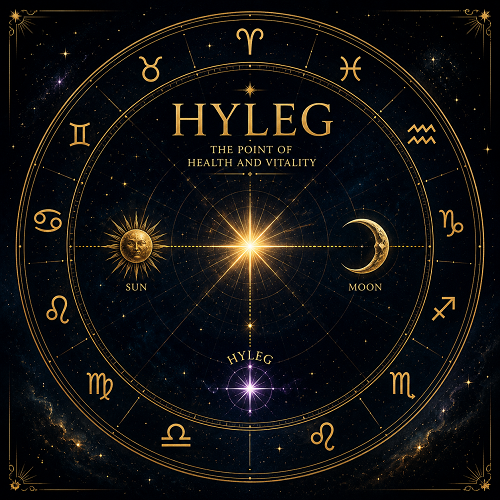
The relationship between the Hyleg and the Ascendant is particularly important. Since the Ascendant represents the physical body, a harmonious connection between it and the Hyleg indicates alignment between the life force and the physical form. This alignment supports health and resilience. When this connection is strained, it may suggest a disconnect between vitality and physical condition, potentially leading to health challenges.
Another key consideration is the role of the Alcocoden, a classical concept closely linked to the Hyleg. The Alcocoden is the planet that governs the length and strength of life, often determined by its relationship to the Hyleg. While the Hyleg represents the source of life, the Alcocoden provides a measure of how that life is sustained over time. Together, they form a complex system for evaluating longevity and vitality.
In modern practice, the concept of the Hyleg is often simplified, with greater emphasis placed on the Sun, Moon, and Ascendant collectively. However, the traditional approach offers valuable insights into the deeper structure of vitality. It encourages a more nuanced understanding of how life force operates within the chart.
It is important to approach the concept of the Hyleg with balance and perspective. While it can indicate strengths and vulnerabilities, it should not be used to make rigid or deterministic predictions. Health is influenced by many factors, including lifestyle, environment, and personal choices. The Hyleg provides a symbolic framework for understanding these influences, not a fixed outcome.
From a practical standpoint, understanding the Hyleg can guide individuals in supporting their vitality. If the Hyleg is weak, emphasis can be placed on strengthening the body through proper nutrition, rest, and stress management. If it is strong, it can be maintained through balanced living and awareness of potential excesses.
Ultimately, the Hyleg represents the essence of life within the chart. It is a reminder that vitality is not merely physical but is deeply connected to the overall harmony of the individual. By understanding and supporting this life force, one can cultivate resilience, maintain balance, and enhance overall well-being.
| • Calculate longevity potential using classical Hyleg and Alcocoden techniques. |