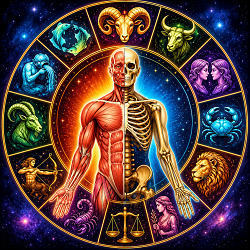
Medical Astrology views the zodiac as a symbolic yet remarkably precise map of the human body. Each of the twelve signs corresponds to a specific region, beginning at the head and progressing downward to the feet. This arrangement reflects a natural order, often referred to as the “cosmic man” or Zodiacal Man, where the human form mirrors the structure of the heavens.
This system provides a foundational tool for understanding how and where health imbalances may manifest. While the planets describe the nature and cause of disease, the zodiac signs indicate the location within the body where these influences are most likely to operate.
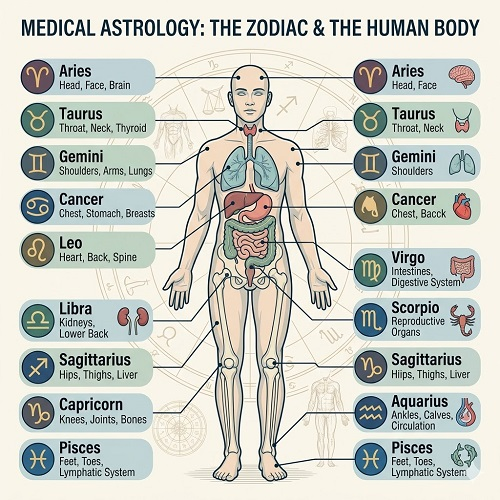
Aries, the first sign of the zodiac, governs the head, brain, and face. It represents vitality, initiative, and the spark of life. When afflicted, it may produce headaches, migraines, fevers, or injuries to the head. Individuals with strong Aries influence often possess abundant energy, but they may also be prone to impulsive actions that lead to physical strain or accidents.
Taurus follows, ruling the neck, throat, vocal cords, and thyroid gland. It is associated with stability and endurance. Health issues linked to Taurus often involve sore throats, thyroid imbalances, or stiffness in the neck. Because Taurus is connected with comfort and indulgence, excessive eating or sedentary habits may contribute to health concerns.
Gemini governs the arms, shoulders, hands, and lungs. It is closely tied to communication and the nervous system. As a result, Gemini-related health issues often involve respiratory conditions, nervous tension, or coordination problems. Individuals with strong Gemini influence may experience stress-related ailments due to mental overactivity.
Cancer rules the chest, breasts, and stomach, making it deeply connected to nourishment and emotional well-being. This sign highlights the strong link between emotions and digestion. When afflicted, Cancer may manifest as indigestion, gastric disturbances, or fluid retention. Emotional stress often plays a significant role in these conditions.
Leo governs the heart, spine, and upper back. It represents vitality, courage, and the central life force. A strong Leo influence often brings resilience and physical strength, but afflictions may lead to heart strain, circulatory issues, or spinal problems. The health of Leo is closely tied to emotional expression and self-confidence.
Virgo is associated with the digestive system, particularly the intestines and assimilation processes. It reflects how the body processes and absorbs nutrients. Virgo-related health concerns often include digestive disorders, intestinal sensitivity, and issues arising from stress or over-analysis. Individuals with strong Virgo influence may be particularly sensitive to diet and lifestyle habits.
Libra governs the kidneys, lower back, and balance within the body. It emphasizes harmony and equilibrium. Health issues associated with Libra often involve kidney function, fluid balance, or back pain. Because Libra seeks balance, imbalances in this sign may arise from extremes or lack of moderation.
Scorpio rules the reproductive organs and elimination systems. It is associated with transformation, regeneration, and deep internal processes. Health concerns linked to Scorpio may include hormonal imbalances, infections, or issues related to detoxification. This sign often indicates conditions that require profound healing or transformation.
Sagittarius governs the hips, thighs, and sciatic nerves. It is connected to movement, expansion, and physical activity. Health issues may include hip pain, muscle strain, or sciatica. Individuals with strong Sagittarius influence often benefit from regular physical activity, as stagnation can lead to discomfort.
Capricorn rules the knees, bones, joints, and skeletal system. It represents structure, endurance, and discipline. Health concerns may include arthritis, joint stiffness, or bone weakness. Capricorn is often associated with chronic conditions that develop slowly over time, emphasizing the importance of long-term care.
Aquarius governs the calves, ankles, and circulatory system. It is linked to innovation and the flow of energy throughout the body. Health issues may involve poor circulation, cramps, or nervous tension. Aquarius-related conditions often appear suddenly or unpredictably.
Pisces, the final sign, governs the feet and the lymphatic and immune systems. It represents sensitivity and absorption. Health concerns may include weak immunity, fluid retention, and susceptibility to infections. Pisces individuals may be particularly sensitive to their environment, including toxins and emotional influences.
Beyond these physical correspondences, the zodiac signs also influence health through their elemental nature. Fire signs (Aries, Leo, Sagittarius) are associated with heat, energy, and vitality. They tend to have strong constitutions but may be prone to inflammation and fever. Earth signs (Taurus, Virgo, Capricorn) are stable and grounded but may experience slower recovery and chronic conditions. Air signs (Gemini, Libra, Aquarius) are linked to the nervous system and mental activity, often leading to stress-related issues. Water signs (Cancer, Scorpio, Pisces) are highly sensitive, with a strong connection between emotions and physical health.
The modalities of the signs further refine their influence. Cardinal signs initiate action and may experience sudden health issues. Fixed signs are strong but resistant, often associated with chronic conditions. Mutable signs are adaptable but may experience fluctuating or recurring illnesses.
It is essential to understand that the zodiac does not act in isolation. The presence of planets within a sign, as well as their aspects, determines how strongly these influences manifest. For example, Mars in Aries may intensify the risk of head injuries, while Saturn in Capricorn may increase the likelihood of joint problems.
Ultimately, the zodiac provides a framework for understanding the body as an interconnected system. It reveals not only areas of vulnerability but also pathways for maintaining balance and health. By recognizing these patterns, individuals can take proactive steps to support their well-being.