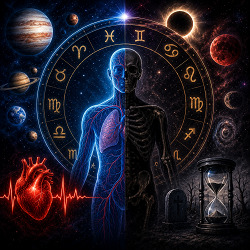
The concept of “early death” in astrology is best understood not as a fixed outcome, but as a symbolic representation of weakened vitality, developmental challenges, or critical phases in life where the individual may face significant health or environmental stress. These indicators highlight where the life force may be compromised, particularly in early stages of life, and where support—both physical and emotional—is most needed.
One of the primary factors considered in this context is the condition of the Ascendant and its ruler. Since the Ascendant represents the physical body and its capacity to sustain life, severe afflictions to it may indicate a fragile constitution. For example, when the Ascendant is under strong pressure from challenging planetary aspects—particularly from Saturn or Mars—it may suggest physical vulnerability. Saturn may indicate weakness, restriction, or developmental delay, while Mars may point to risks involving injury, inflammation, or sudden events.
The condition of the Hyleg, or giver of life, is equally important. A weakened or heavily afflicted Hyleg has traditionally been associated with reduced vitality. If the Hyleg lacks support from benefic planets or is placed in a weak position within the chart, it may indicate that the life force requires additional support. In modern interpretation, this is seen as a signal for increased care, rather than a prediction of outcome.
The Moon also plays a crucial role, particularly in early life. As the ruler of bodily rhythms, nourishment, and emotional security, the Moon reflects the environment in which the individual develops. An afflicted Moon may indicate challenges related to early nurturing, emotional stability, or physical adaptation. Such conditions can influence both physical health and psychological development.
Another important factor is the presence of malefic planets in key positions, particularly in the first, sixth, or eighth houses. These houses are closely associated with the body, illness, and transformation. Strong afflictions involving these areas may indicate periods of heightened risk or significant health challenges. However, it is essential to interpret these placements in context, considering the overall balance of the chart.
In classical astrology, combinations involving multiple afflictions—such as a weak Ascendant, an afflicted Hyleg, and malefic influences in key houses—were often taken as indicators of early death. Modern astrology, however, recognizes that such combinations are better understood as risk patterns rather than certainties. Many individuals with challenging charts live long and fulfilling lives, particularly when they receive proper care and support.
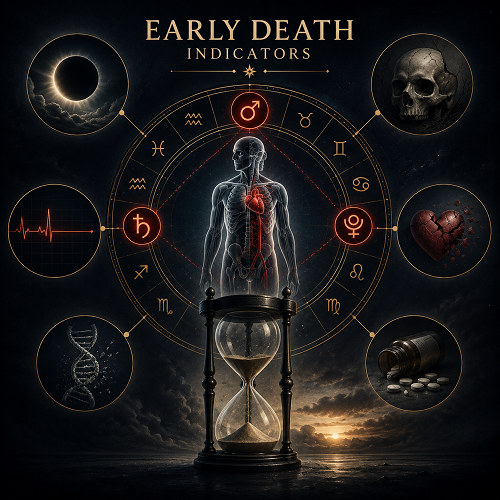
Timing techniques also play a role in identifying periods of vulnerability. Planetary transits and progressions can activate sensitive points in the chart, bringing temporary challenges. For example, a difficult transit from Saturn may coincide with a period of physical weakness or increased responsibility, while a Mars’ transit may bring heightened activity or risk. Understanding these cycles allows for greater awareness and preparation.
It is also important to consider non-astrological factors. Advances in medicine, improved living conditions, and greater awareness of health have significantly altered the outcomes that might have been expected in earlier times. What may have once been a serious or life-threatening condition can now often be managed or treated effectively. This highlights the importance of integrating astrological insight with modern knowledge and practical care.
From a psychological perspective, the symbolism of early death indicators can also reflect intense transformation or the need for profound change. In this sense, “death” may represent the end of one phase of life and the beginning of another. Individuals with strong transformative patterns in their charts often undergo significant personal growth, emerging stronger and more resilient.
Ethically, it is crucial that such interpretations are handled with care. Astrology should empower, not instill fear. When discussing sensitive topics like early vulnerability, the focus should always be on awareness, prevention, and support. The goal is to help individuals understand their strengths and challenges so they can make informed decisions and cultivate resilience.
Ultimately, the modern approach to early death indicators reframes them as signals of sensitivity rather than sentences of fate. They point to areas where the life force may need reinforcement and where conscious effort can make a meaningful difference. By recognizing these patterns, individuals and caregivers can take proactive steps to support health, ensuring that potential challenges are met with knowledge, preparation, and care.