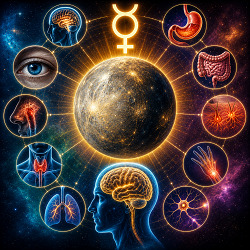
Mercury, in Medical Astrology, represents the principle of communication, coordination, and connection within the body. It governs the nervous system, the brain’s signaling processes, the respiratory system, and the intricate network through which information is transmitted. Unlike planets that rule fixed structures or singular organs, Mercury operates as a functional force, linking different systems and ensuring that the body acts as an integrated whole.
Because of this, Mercurial disorders are often not confined to one area but manifest as disturbances in communication—between brain and body, between organs, or even between mental and physical states. These conditions are frequently variable, elusive, and influenced by mental activity, reflecting Mercury’s inherently changeable nature.
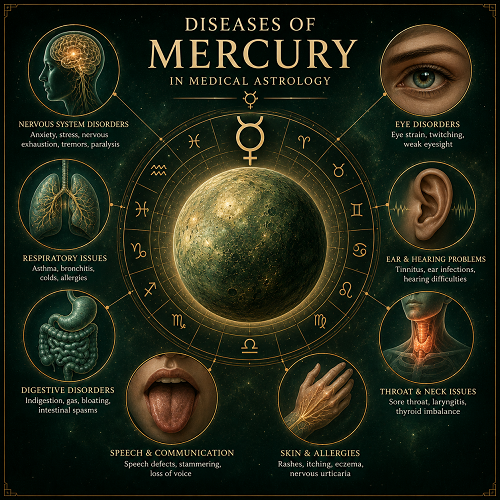
At a physical level, Mercury governs the nerves, lungs, bronchial system, arms, hands, and sensory coordination. It is responsible for reflexes, responsiveness, and the body’s ability to process and react to stimuli. A well-balanced Mercury allows for clarity of thought, quick reflexes, efficient breathing, and smooth coordination. When Mercury is strong, the individual often exhibits mental agility, adaptability, and a well-functioning nervous system.
However, when Mercury is afflicted—particularly by challenging aspects from planets such as Saturn, Mars, or Neptune—its delicate balance can be disrupted. This may lead to a wide range of health issues, many of which are closely tied to the nervous system.
One of the most common manifestations of Mercurial imbalance is nervous tension. This can present as anxiety, restlessness, irritability, or an inability to relax. In more severe cases, it may develop into chronic anxiety disorders, insomnia, or conditions involving heightened sensitivity to stimuli. The individual may feel constantly overstimulated, as if the nervous system is unable to “switch off.”
Mercury also has a strong connection to the respiratory system. Afflictions may lead to conditions such as asthma, bronchitis, allergies, or irregular breathing patterns. These issues are often exacerbated by stress or environmental factors, reflecting Mercury’s responsiveness to external influences. Individuals with Mercury-related respiratory conditions may find that their symptoms fluctuate depending on their mental state or surroundings.
Another significant area influenced by Mercury is mental processing and cognition. When Mercury is under strain, difficulties may arise in concentration, memory, or communication. The individual may experience confusion, scattered thinking, or difficulty expressing themselves clearly. In some cases, this may extend to speech disorders or coordination issues.
Mercury’s mutable nature means that its associated illnesses often lack consistency. Symptoms may come and go, change in intensity, or shift from one form to another. This can make diagnosis challenging, particularly when combined with the influence of Neptune, which may blur or obscure symptoms.
The connection between Mercury and the mind-body relationship is particularly important. Many Mercurial conditions are psychosomatic, meaning that mental stress directly impacts physical health. For example, prolonged anxiety may lead to digestive disturbances, headaches, or fatigue. This highlights the importance of addressing not only the physical symptoms but also the underlying mental and emotional patterns.
The influence of other planets can significantly modify Mercury’s expression. When combined with Mars, Mercury may produce sharp, acute conditions such as mental agitation, sudden headaches, or inflammatory responses affecting the nerves. When influenced by Saturn, Mercury’s functions may become restricted, leading to depression, slowed thinking, or chronic nervous disorders. Neptune’s influence may introduce confusion, hypersensitivity, or conditions that are difficult to diagnose.
From a preventive perspective, maintaining balance in Mercurial energy is essential for overall health. This involves managing mental activity, reducing stress, and ensuring that the nervous system is not overstimulated. Practices such as meditation, controlled breathing, and regular rest can be particularly beneficial.
Lifestyle plays a crucial role in managing Mercury-related conditions. A structured routine helps stabilize Mercury’s tendency toward fluctuation. Limiting excessive mental stimulation—such as constant exposure to information or overthinking—can also reduce nervous strain. Physical activities that promote coordination, such as yoga or light exercise, help integrate the mind and body.
Dietary considerations may also support Mercurial health. Light, easily digestible foods that do not overstimulate the system are generally beneficial. Avoiding excessive stimulants, such as caffeine, can help maintain balance in the nervous system.
Ultimately, Mercury-related diseases highlight the importance of connection and communication within the body. They remind us that health depends not only on physical strength but also on the efficient functioning of the systems that link the body together. By cultivating mental clarity, emotional balance, and a supportive lifestyle, individuals can harmonize Mercurial energy and maintain overall well-being.